10 years of rising numbers of wasted empty homes…
-
The official numbers:
Long-term empty homes 303,185 - up over 50% since 2016
(51.5% rise since the National Empty Homes Programme ended)
All vacants [excludes second homes] 754,264 UP 28% since 2016
[Total official vacancy 1,022,158 including 267,894 ‘2nd homes’ which have not switched to pay business rates]
Of note:
Class F ‘Council tax exempt empty homes’ 124,064 – up from 72,200 in 2012 – an increase of 72%
- Research with councils suggests this feeds into long-term vacancy – after leaving Class F status many of these have been classified as ‘furnished empties’ and thus as ‘second homes’. These have not been subject to premiums until 2025, where implemented [the first 2nd home premiums became effective April 2025]
Census 2021 suggested higher overall vacancy (of 1.5m) in England [see this link for ONS commentary]
-
Our insights for national policy:
The Council Tax Premium regime has not reduced numbers.
However, the new premium at one year empty and the new Second Homes Premium do now appear to be incentivising many councils to more effectively categorise previously un-taxed or hidden empty homes.
The constrained Empty Dwelling Management Order (or EDMO) power is ineffective (after the Coalition Government weakened it).
We recommend a more effective power and removal of the two-year wait - one year would be more effective, or a return to six months, as originally envisaged – MHCLG statements suggest action is being considered in this area, but thus far no change has been made.
The rise in empty homes numbers commenced from 2017 and has continued to date; the increase is seen in both long-term empties and ‘all vacants’. This increase in vacancy started immediately after the last national Empty Homes Programme of targeted funding ended in 2015/16.
That programme did yield positive results, alongside incentives for Councils to act such as the availability of the New Homes Bonus for bringing long-term empties back into use. Results were achieved both through support for council initiatives and through work with community-based housing providers.
See discussion and evaluations in the House of Commons Library Report HERE (link) – note section on Coalition Government policy 2012-15.
Growing numbers of empties at a time of intense housing crisis create public concern and represent a missed opportunity to bring more stock back into use more quickly
We call for a new national funding programme with targeted funding devolved to local councils and for support for local community housing initiatives focused on retrofitand bringing empty homes into use (see link) to meet local housing needs.
We have also worked with a range of partners to advocate for the introduction of a national empty homes acquisition initiative, with the additional housing supply produced by bringing empty homes back into use being targeted toward alleviation of urgent housing needs. We have already seen some regional examples of this proposal being adopted, with Greater Manchester Combined Authority recently launching such as initiative.
Our full range of policy insights regrading national policy options for alleviating vacancy are also included in the 2024 University of Sheffield report on Coastal and Rural Vacancy across the UK which we co-authored and which is available for free download HERE
See the next section for more details and links to some of the policy proposals we have developed with our partners, such as Crisis and Shelter.
-
Our partners share our vision to use empty homes
Alongside partners including Crisis and Shelter we have called for a new National Empty Homes Programme in England (Scotland and Wales already have programmes).
Both Crisis and Shelterhave published dedicated reports addressing this opportunity to add urgently needed affordable housing supply, with our input
Crisis in their ‘Lets End Homelessness With Homes - Unlocking the Potential of England’s empty buildings’ report on using empty property to meet the most urgent housing needs and Shelter in their ‘Home Again’ report which includes a proposal for a: ‘10 Cities Empty Homes pilot programme’, see link to report and programme proposal HERE.
We recommend targeted use of empties to meet housing need where possible and where this is financially viable, as Shelter have modelled in the ‘Ten Cities’ pilot proposal - and we are confident that even more ambitious results and targets are achievable, if linked to a wider acquisition and tenure conversion programme.
Our proposal to use Capital Gains Tax Relief to encourage sales into social use has been supported and adopted by both Shelter and Crisis. This has been proposed as an exit route for over-leveraged small landlords or those unwilling to invest in upgrades to meet new Private Rented Sector regulations in areas such as minimum standards of insulation (EPC ‘C’).
The validity of this approach is demonstrated by existing acquisition programmes which bring ex-local authority homes sold off via Right To Buy and other empty stock into use as social housing; or which see councils acquiring homes for use to meet urgent Temporary Accommodation needs – e.g. London’s ‘Right to Buy Back’ / Council Homes Acquisition Programme
Also relevant is work done on this by the Affordable Housing Commission - which proposed a ‘PRS to Social’ Conversion Fund’ - this included recommendations on the aquisition of privately owned empty homes to convert to social use.
The Affordable Housing Commission also produced a full set of proposals to rebalance the nation’s housing system through re-establishing greater access to social and genuinely affordable housing as the concluding report of this programme of work (in 2020).
Retrofit of empty homes is at the core of our work because this produces additional housing supply which is cheaper and healthier to live in as well as offering an opportunity to build skills, experience and supply chains as we prepare to meet the challenge of NetZero targets.
The easiest home to retrofit is an empty one - here is why this matters:
Offers an opportunity to build skills in retrofitting a variety of typical domestic home typologies (as will be required)
Can be used to pilot approaches to training and to support the development and viability of local supply chains (including materials sourcing and manufacturing)
Bottom-up approaches driven by devolution of funding to local councils are likely to be most effective and align with the new Government’s developing approach.
Action on Empty Homes have also produced a set of broader social policy recommendations including implications for regional; devolution in our landmark report with the University of Sheffield on Rural and Coastal Vacancy
-
Regional variations show that we are getting England’s housing wrong:
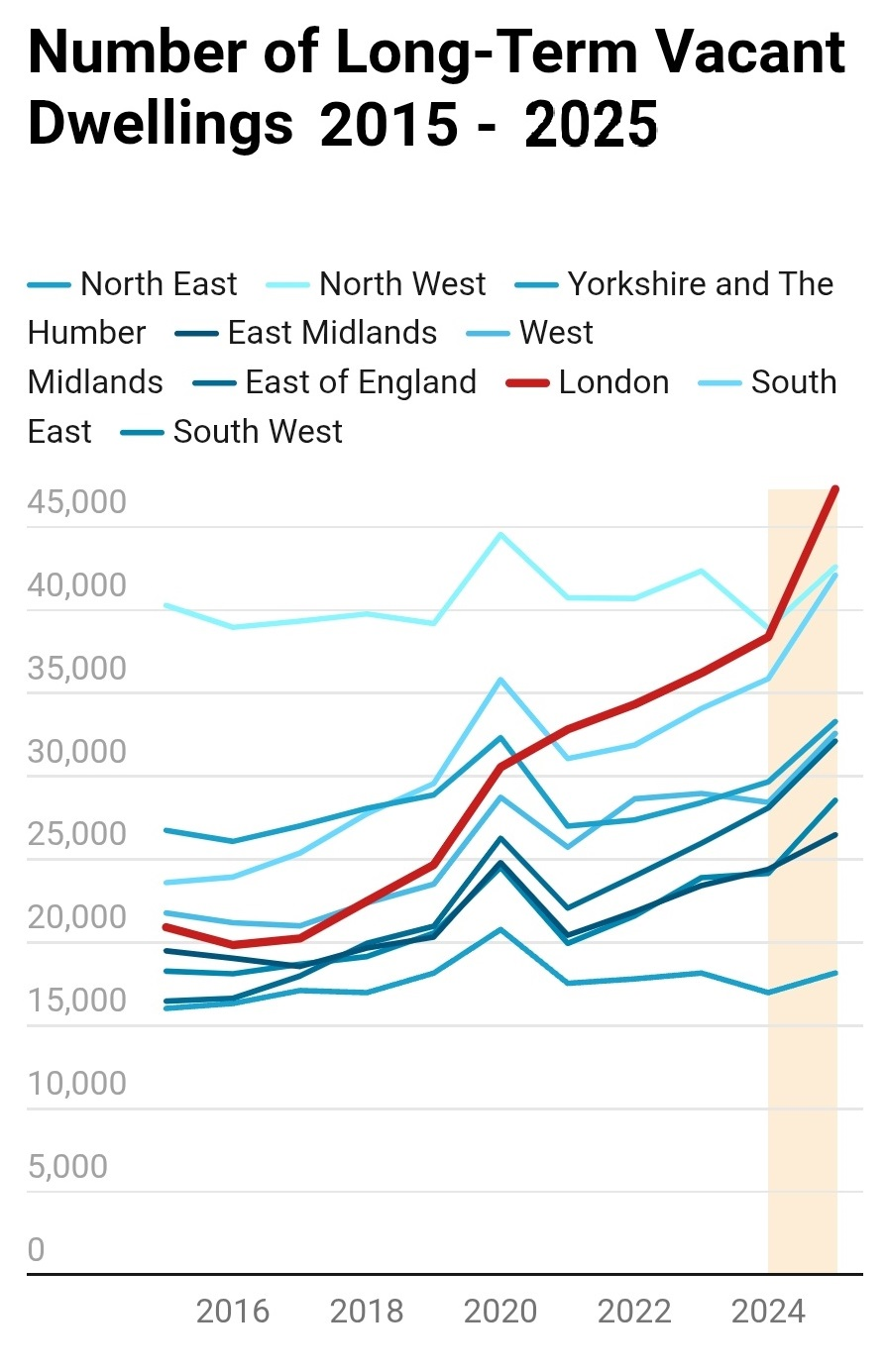
While long-term empty homes have risen 51.5% across England as a whole, in the period since 2016, they have MORE THAN DOUBLED in London – rising by a massive 138% and there is very significant regional variation.
o This suggests the impact of wealth storage, investment strategies, or other factors such as unrealistic pricing and lack of affordability in newbuild. These are keeping more homes empty for much longer in the capital.
o A far smaller rise in local authority and Private Registered Provider empties in the capital over this period, some of this due to estate regeneration schemes, is not sufficient to explain this.
o The vacancy level of 1 in every 24 homes empty is now virtually identical in London and the North East - with overall vacancy actually slightly higher in London.
o Regions exhibit rises very variably, the North East and North West show the least increase ( – see below).
o The South West is the most vacant region overall, with one in every 21 homes out of use.
o The West Midlands is the least vacant region, with one home in every 29 currently out of use.
If you are interested in data at a local level in your area, this is available for every council on our Facts and Figures page, as well as by region, or you can reach us anytime via our contact page or email. We aim to respond quickly—usually within one business day.
-
Regional breakdown of rising numbers of long-term empty homes 2016 [base] – 2025 [most recent data]:
Eastern England: Up 93%
Long-term 32,081; total 112,074
2025 rise: 14%
London: Up 138%
Long-term 47,287; total 161,116
2025 rise: 23%
South East: Up 76%
Long-term 42,099; total 155,579
2025 rise: 17%
South West: Up 58%
Long-term 28,553; total 128,550
2025 rise: 18%
North East: Up 11%
Long-term 18,164; total 52,699
2025 rise: 7%
North West: UP 9%
(after a 0.19% drop to 2024)
Long-term 42,606; total 137,158
2025 rise: 10%
Yorks & Humber: Up 28%
Long-term 33,293; total 102,169 2025 rise: 12%
East Midlands: Up39%
Long-term 26,475; total 80,834
2025 rise: 9%
West Midlands: Up 54%
Long-term 32,585; total 92,254
2025 rise: 15%
-
Comparing 2021 census data to the Council Taxbase reveals a 50% higher residential vacancy rate. Covid impacts on the 2021 census have been explored but fail to comprehensively explain this. It is notable that in London as a whole this variation was in excess of 100% - even after counting recorded second homes for that year. The 2021 census recorded vacancy in London as approaching 300,000 homes.
o This underlines the need for more comprehensive and consistent data on residential property ownership and usage - Note the ‘hidden’ and ‘unexplained’ vacancy in the ‘tens of thousands’ that Cllr Adam Hug, Local Government Association Housing Spokesperson and Westminster Council Leader until 2026 cited, estimating vacancy in Westminster alone as almost 40,000 homes.
o This suggests implications for upcoming developments in short-let licensing, emphasising the need for a comprehensive scheme for all short lets featuring use of Unique Property Reference Numbers (UPRNs)
o It is also critical that the National Private Rented Sector Landlord Database legislated for by the government in the Renters Rights Act 2025 should also use the existing UPRN system to identify homes.
o Alongside a wide range of partners AEH have proposed a UPRN-linked national property usage and ownership register, with access available to local council enforcement officers and to HMRC.
o In assessing (and implementing) changes to capital gains tax regimes for either additional properties or primary residential property, improved information on property usage and ownership will be key; this appears to be a significant issue which is currently impeding accurate taxation and regulation, both at national and local levels of Government in England.