
In London, Long-Term Empty Homes Have More Than DOUBLED Since 2016

With over half of all homeless families in Temporary Accommodation placed there by London Councils, the nations housing crisis is London’s Housing Crisis - so how can it be possible that vacancy in the capital has more than doubled in less than a decade?
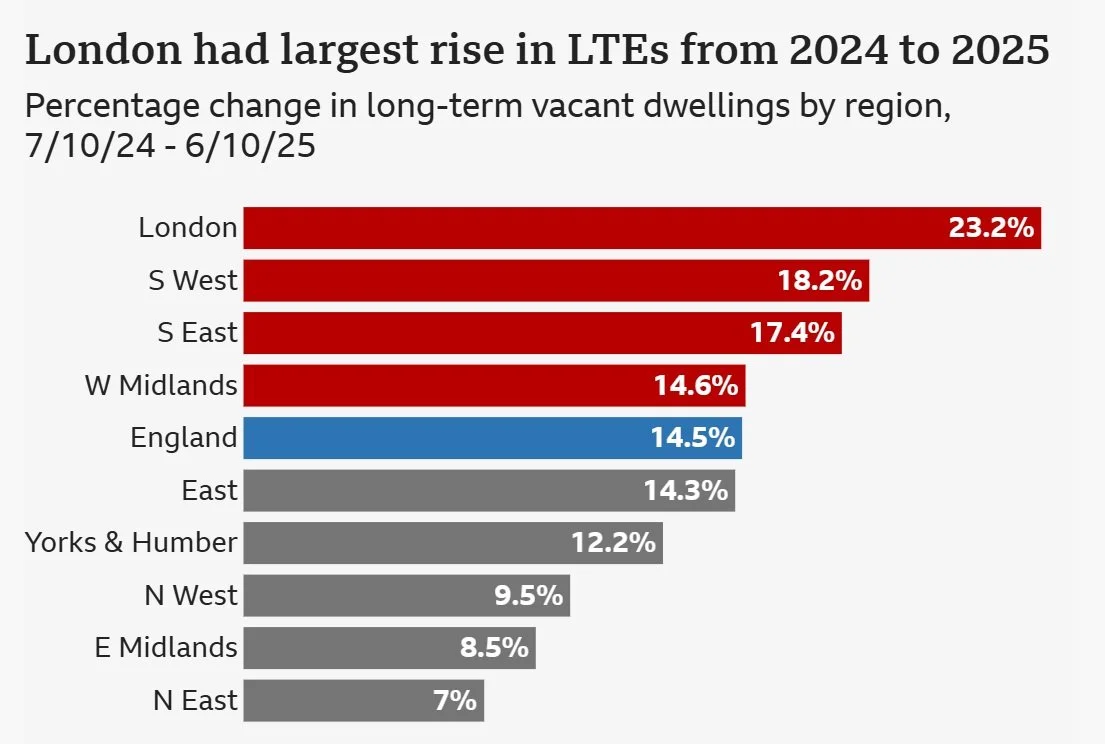
2025 saw long-term empty homes rise in EVERY REGION of England - nationally numbers rose 14% to over 300,000 long-term empties, while total vacancy topped 1 million homes across England.
Bad as this is, the national pattern hides extremely significant regional differences which tell a shocking story of their own.
This is because for much of the last decade we have seen the most significant rises occurring in areas which are also seeing rapidly rising homelessness.
2025’s latest data saw long-term empty homes in London rise by almost a quarter (up 23%), one of the largest rises on record, while the South West (England’s most vacant region) saw numbers rise 18% and the South East region rose 17%.
London is the only region in England to have experienced increases in residential vacancy every year since 2016, and it has done so in the midst of an affordable housing shortage and while more and more homeless households have been forced into temporary accommodation. In fact well over half of all families in Temporary Accommodation are Londoners.
As house prices and rents have risen throughout the capital in recent years, so have the number of homes which have remained unfurnished and empty for longer than six months. The latest November 2025 council tax data shows that the number of long-term empty homes across the city rose steeply in 2025, to over 47,000, while London boroughs struggled to find suitable accommodation for record numbers of homeless families.
The data shows the number of long-term empty homes in London increased to 47,287 in 2025 - a huge increase of 23% over the previous year's total. While total vacancy in the city topped 160,000 (at 161,116).
The number of empty homes reported across London boroughs, now represents an overall officially reported vacancy level of 1 in every 24 homes. While the number of long-term empty homes in the capital has more than doubled since 2016, rising 138%, since England’s most recent national Empty Homes Programme ended.
This is a staggering shift in housing stock in any context, but bearing in mind the particular intensity of London’s housing and affordability issues, the loss of nearly 50,000 more homes to long-term vacancy in only 9 years underlines the importance of both a new Empty Homes Programme and a new approach to Housing supply in London.
Shelter in their latest report - referencing Action on Empty Homes work and research - have called for a needs-based approach to newbuild. This short Shelter video explains why the current approach to housing in London is not only failing but is actually making housing poverty and homelessness worse - and why we have to stop the madness of saying that the answer to our housing crisis is more of the wrong housing for Londoners (and more vacancy).
In other words it is time that we stopped building the wrong housing in London to solve our housing crisis.
London’s 138% increase in the number of long-term empty homes since 2016 highlights the deeply rooted issues driving vacancy across the capital. These range from insufficient local authority planning powers to prioritise primary residential use in new housing developments, to the inability of Empty Dwelling Management Orders to serve as effective tools for councils to bring existing long-term empty stock back into use.
Critically London’s affordable housing shortage is not about constrained supply, for all the talk of low newbuild numbers in the current year. London has seen unparalleled financial investment in new-build housing development over the past decade and added well over 300,000 homes.
Research conducted by Action on Empty Homes has shown that this investment has actually worsened the city’s housing crisis by yielding swathes of unaffordable dwellings and fueling rapid escalations in land costs. Rising land costs have in turn driven up house prices and rents, while fuelling an explosion of hi-rise, high carbon impact, expensive to build and maintain tower model so-called luxury flats.
London councils have been hugely ill-equipped to deal with an influx of international capital which has in effect reshaped and repurposed the city’s housing stock. Consequently new powers are needed in order to better regulate development and better incentivise owners of empty homes to return their properties to use or sell them to those intending to bring them back into residential use.
Local authorities in London are already buying homes to reduce temporary accommodation requirements and boost social stock and have the ability to use up to 30% of Government Housing Funding (SAHP) to do this - whereas local authorities outside the capital can use only 10% of funds in this way. But this programme in London having purchased 1,500 homes during its initial phase is only scheduled to purchase a further 10,000 over a 10-year period.
However, to make a real impact far greater additional targeted funds would be needed alongside policy changes to deliver the return of significantly more empty homes to use - and critically to target these to meeting housing need as social homes.
What is inarguable however, is that this investment can be expected to produce significant positive financial return, as an expansion of council-owned housing stock reduces the need for expenditure on temporary accommodation, which reached over £5million a day in 2025 (over £2 billion annually) across London boroughs.
The National Empty Homes Programme, which existed under the coalition government between 2012-15, made funding available for councils and communities to bring empty properties back into use as affordable housing, and could serve as a guide for enabling local action on empty homes. In 2014, empty homes reached a ten-year low in England, and over the course of the programme up to 100,000 long-term empty homes were returned to use across the country.
No region in England has equalled London’s year-on-year surge in long-term empty homes since the end of the National Empty Homes Programme. However, Eastern England posted the second largest increase of 93% since 2016 while the South East was not far behind on 76%.
Despite reports of an acute shortage of homes across London, total vacancy has now reached a 15 year high, further supporting the importance of a renewed National Empty Homes Programme which could play a crucial role in quickly mitigating England’s affordable housing shortfall.
The findings emerging from the 2025 council tax data exemplify the need for approaches to relieving housing affordability pressures across London that don’t hinge on large newbuild targets, especially when it is clear that councils are under-equipped to ensure new-builds are priced appropriately for, and made accessible to, local residents.
Without a renewed national programme and further powers for local authorities, London’s housing stock will continue to be carved out by vacancy at the same time as rent and house prices surge and increasing numbers of households find themselves homeless and in council-funded temporary accommodation.